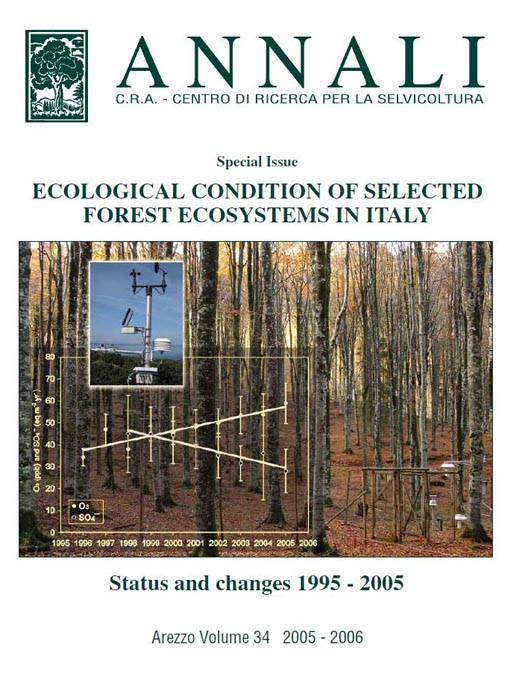
Soil solution chemistry at one mountain beech (Fagus sylvatica L.) CONECOFOR plot, 1999 to 2005
DOI:
https://doi.org/10.12899/asr-904Keywords:
beech forest, soil solution, trends.Abstract
Soil solution monitoring aims to understand various temporal scales of soil processes. The first eight years of observation in ABR1 Level II site have brought significant elements of understanding about the shorter temporal scales. It is suggested that certain solutes, regularly produced by forest floor microbial processes, are transferred to the highly mobile portion of the soil solution by a non linear process, producing irregular pulses and creating a strong high frequency component. Seasonal processes remain nonetheless detectable after simple and rough filtering. A multi-year trend of diminished nitrate mineralization and increased pH of forest floor solutions is possible. It is estimated that much more accurate analysis will be possible in a relatively short time span of further monitoring.
References
Cecchini G., Carnicelli S., Mirabella A., Mantelli F., Sanesi G. 2002 - Soil conditions under a Fagus sylvatica CONECOFOR stand in Central Italy: an integrated assessment through combined solid phase and solution studies. In: Mosello, R., B. Petriccione and A. Marchetto (guest editors): Long-term ecological research in Italian forest ecosystems. J. Limnol., 61 (Suppl. 1): 36-45.
Spangenberg A., Bredemeier M. 1999 - Application of spectral analysis to meteorological and soil solution chemistry data. Chemosphere, 39 (10): 1651-1665.
Stein A., Sterk. 1999 - Modeling space and time dependence in environmental studies. J. Appl. Earth Obs. and Geoinformation, 1 (2): 109-121.
Ugolini F.C., Sletten R.A. 1991 - The role of proton donors in pedogenesis as revealed by soil solution studies. Soil Sci., 151: 59-75.
Downloads
Published
How to Cite
Issue
Section
License
Copyright (c) 2013 Guia Cecchini, Stefano Carnicelli, Guido Sanesi

This work is licensed under a Creative Commons Attribution 4.0 International License.
Authors who publish with this journal agree to the following terms: Authors retain copyright and grant the journal right of first publication with the work simultaneously licensed under a Creative Commons Attribution License that allows others to share the work with an acknowledgement of the work's authorship and initial publication in this journal. Authors are able to enter into separate, additional contractual arrangements for the non-exclusive distribution of the journal's published version of the work (e.g., post it to an institutional repository or publish it in a book), with an acknowledgement of its initial publication in this journal. Authors are permitted and encouraged to post their work online (e.g., in institutional repositories or on their website) prior to and during the submission process, as it can lead to productive exchanges, as well as earlier and greater citation of published work (See The Effect of Open Access).