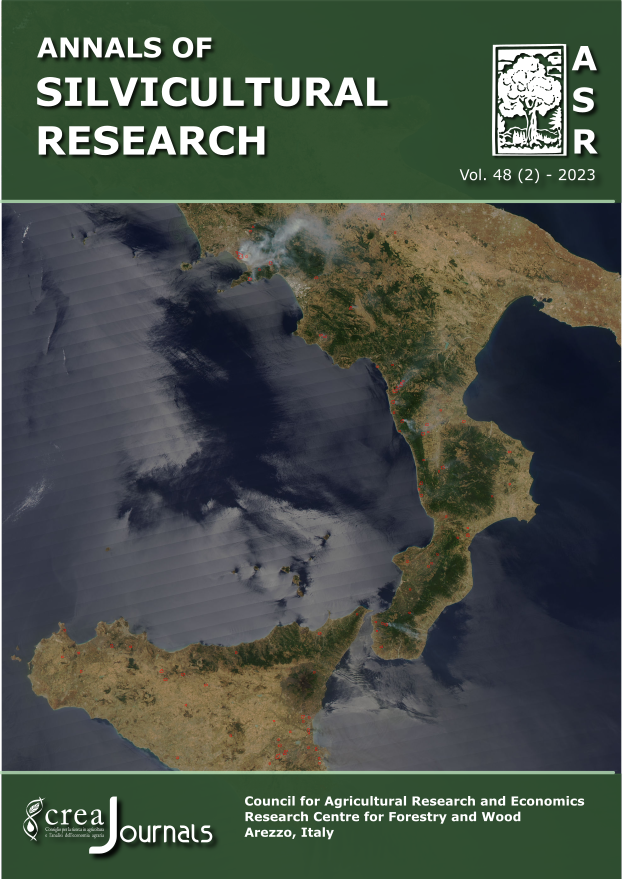
Mapping Regions of Provenance for Italy
DOI:
https://doi.org/10.12899/asr-2441Abstract
In the follow-up of 1999/105/CE Directive on national level, the new map of regions of provenance for forest reproductive materials of Italy is adopted as reference for the national register of forest basic materials. The new map was outlined to match needs linked to the transposition of European legislation to the complexity of the Peninsula’s environment and the national nursery system. The main objective in this technical note is to present the map units in relation to the distribution of main forest species. The map units of ecoregional meaning might facilitate new allocations for forest reproductive materials which are needed to increase genetic diversity. Furthermore, studies on genetic variability of forest species are required to understand the possible interactions between the ecological amplitude of forest species, their actual genetic diversity, and possible adaptation to future climate conditions.
Downloads
Published
Versions
- 2023-04-21 (2)
- 2023-03-06 (1)
How to Cite
Issue
Section
License
Copyright (c) 2023 Fulvio Ducci, Luisa Maria Cagelli, Paolo Camerano, Lorenzo Camoriano, Immacolata Librandi, Giuseppe Pignatti, Alessandra Stefani

This work is licensed under a Creative Commons Attribution 4.0 International License.
Authors who publish with this journal agree to the following terms: Authors retain copyright and grant the journal right of first publication with the work simultaneously licensed under a Creative Commons Attribution License that allows others to share the work with an acknowledgement of the work's authorship and initial publication in this journal. Authors are able to enter into separate, additional contractual arrangements for the non-exclusive distribution of the journal's published version of the work (e.g., post it to an institutional repository or publish it in a book), with an acknowledgement of its initial publication in this journal. Authors are permitted and encouraged to post their work online (e.g., in institutional repositories or on their website) prior to and during the submission process, as it can lead to productive exchanges, as well as earlier and greater citation of published work (See The Effect of Open Access).